Rail Profile Management in Indian Railways 2026: Essential measurement practices for track engineers
February 26, 2026
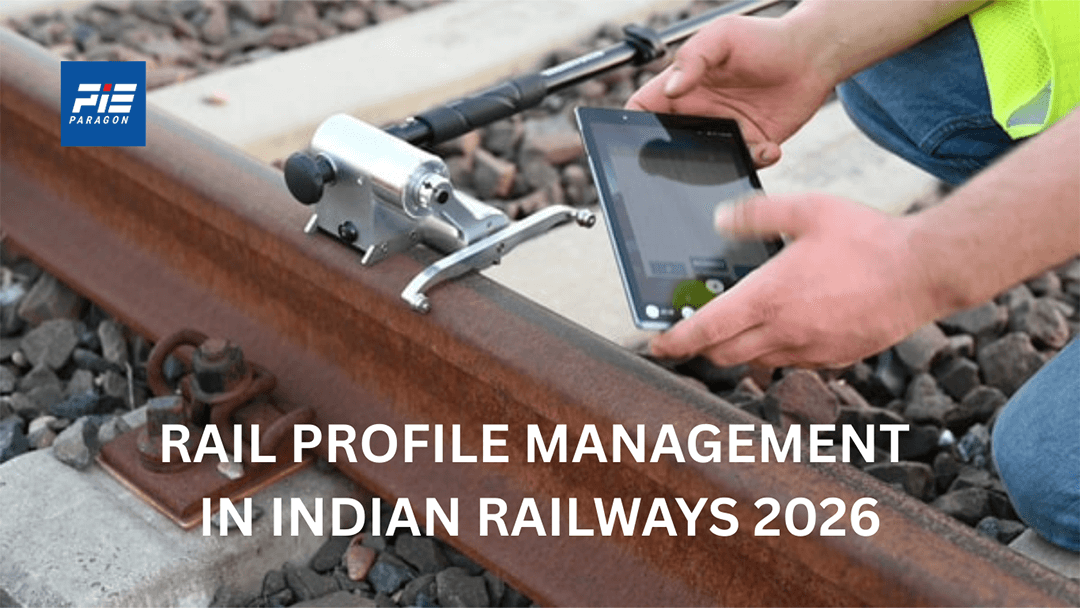
Rail profile management has become a cornerstone of predictive maintenance across India’s expanding railway network. With a record budgetary allocation of Rs 2.81 lakh crore for FY 2026-27 and plans for 1,000 new trains over a period of next 5, maintaining optimal rail profiles is essential for safety and operational efficiency.
For Permanent Way Engineers (PWI), Divisional Engineers (DEN), and track maintenance contractors, understanding modern rail profile monitoring is crucial to preventing costly failures, improving ride comfort and ensuring compliance with RDSO specifications.
This guide explains how accurate rail profile measurement supports grinding programs, why condition-based monitoring is replacing fixed-schedule inspections, and what measurement instruments Indian Railways zones and contractors need.
Paragon Instrumentation Engineers Pvt. Ltd. offers a comprehensive range of railway track measurement instruments with RDSO compliance, ISO/NABL calibration, and pan-India service support.
Why Rail Profile Management Matters Now?
Indian Railways Performance Context:
- Carries over 7 billion passengers yearly
- Produces 1,500 locomotives and 30,000 wagons annually
- Expanded 35,000 km of track network as of 2025
- Achieving 99.38 kmph average speeds on EDFC, 89.50 kmph on WDFC
This growth brings higher axle loads, increased freight traffic on Dedicated Freight Corridors, and faster train speeds—all accelerating rail wear.
Core Rail Profile Challenges:
Rolling Contact Fatigue (RCF) — Surface cracks from repeated wheel-rail contact that can propagate beneath the surface and lead to rail breaks
Rail Corrugation — Periodic deformations that develop exponentially if not addressed early, causing noise and accelerating component wear
Gauge Corner Cracking — Particularly problematic on curves and turnouts where lateral forces concentrate stress
Vertical and Lateral Wear — Reduces rail life and affects ride quality, requiring accurate measurement for maintenance planning
Delhi Metro Case Study: DMRC estimated rail in curves would need replacement within 12 years without aggressive grinding programs—a financially untenable scenario driving adoption of preventive maintenance.
Several Key Trends Shaping Rail Profile Management
Trend 1: Condition-Based Maintenance Replaces Fixed Schedules
What’s Changing:
Indian Railways is shifting from calendar-based grinding to condition-monitoring. Instead of grinding every X months, teams now measure rail profiles regularly and grind only where deterioration exceeds thresholds.
Around 2,000 km of rail routes are expected to benefit from predictive maintenance systems in 2024, reducing operational delays and enhancing safety.
Implementation Requirements:
- Regular profile measurement using portable gauges or track geometry trolleys
- Digital data storage for trend analysis
- Predictive algorithms to forecast crack growth
- Targeted grinding based on measured deterioration
Paragon Solution: Digital Rail Profile Gauge Cum Recorder (RPCS Basic 2.0) with Android tablet integration for data logging and trend analysis
Trend 2: Advanced Rail Grinding Technologies
While Paragon specializes in measurement instruments (not grinding equipment), understanding grinding practices helps engineers specify the right inspection tools.
Modern Grinding Equipment Providers:
- Harsco ( USA ) – Grinding machines and switch grinders being used by Indian Railways and Metros
- Loram (USA) — High-output grinding trains used by Indian Railways
- Plasser & Theurer (Austria) — Automated grinding systems with closed-loop control – Learn more:
The Measurement Connection — Effective grinding programs require:
- Pre-grinding measurement to identify problem areas
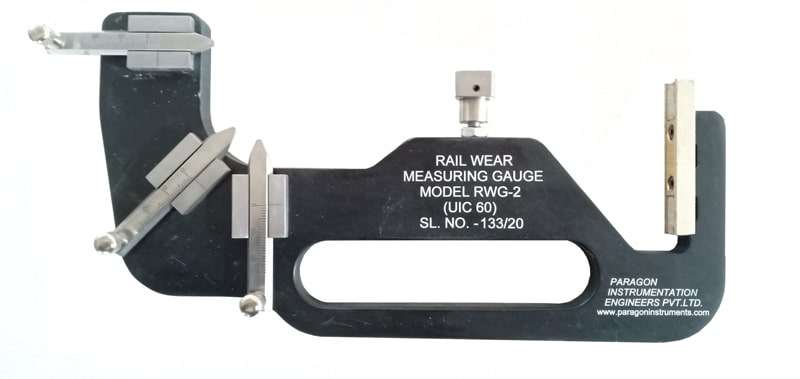
- Post-grinding verification using rail wear gauges
- Periodic monitoring between grinding cycles
Paragon Products for Grinding Program Support:

Trend 3: Portable Measurement Systems for Divisions
Challenge: Large track recording cars have limitations—high cost, limited availability, scheduling constraints
Solution: Portable inspection tools divisions can deploy independently during short maintenance blocks
Portable Measurement Advantages:
- Rapid deployment during limited nighttime windows
- Ideal for depots and yards where track recording cars don’t operate
- Immediate pass/fail assessment for quick decisions
- Data upload to maintenance planning systems
- Zone-specific availability without central scheduling
Measurement Instrument Selection Matrix
| Project Type | Primary Instrument | Secondary Tool | Frequency |
|---|---|---|---|
| Plain Line Maintenance | Rail Profile Gauge | Track Geometry Trolley | Monthly/Quarterly |
| Grinding Program Verification | Rail Grinding Gauge | Rail Wear Gauge | Post-grinding + 3-month intervals |
| Metro/Urban Rail | Digital Profile Gauge | Corrugation Measurement | Weekly/Bi-weekly high-wear zones |
| Turnout/Crossing Maintenance | S&C Measurement Gauges | Rail Wear Gauge | Quarterly/Semi-annual |
| New Track Acceptance | Rail Profile Gauge | Track Geometry Trolley | At takeover + commissioning |
| DFC/High-Speed Lines | Track Geometry Trolley | Digital Profile Gauge | Bi-weekly/Monthly |
| Export Rail Projects | Internationally Certified Gauges | Digital Data Loggers | Per client specifications |
Decision Framework for Railway Measurement Instruments
Non-Negotiables (Must Have):
- RDSO and EN standard specification compliance
- ISO/NABL calibration certificate availability
- Operating temperature range -20°C to +50°C minimum
- Local service support within your Railway Zone
High Priority (Strongly Preferred):
- Digital data logging and export capability
- Calibration turnaround under 5 days
- Regional spare parts availability (24-48 hour access)
- Field training included with purchase
- Transparent pricing and service documentation
- Pan-India service network for transferred engineers
Conclusion
Selecting the right railway measurement instruments depends on:
1. Application type — Match instrument capabilities to plain line, turnouts, grinding verification, or acceptance testing
2. RDSO compliance — Meet specification requirements with proper documentation for tender submissions
3. Field conditions — India’s extreme temperatures, dust, and monsoon humidity demand proven durability
4. Service support — Local calibration and technical assistance minimize possession delays
The right measurement instrument isn’t the cheapest or the most sophisticated—it’s the one that delivers reliable data when track safety depends on it, backed by a vendor who provides rapid support across India’s 19 Railway Zones.
Paragon Instrumentation Engineers has served Indian Railways, metro corporations, and contractors for over 60 years with:
- RDSO-compliant instruments with complete technical documentation
- One week calibration turnaround (vs. 7-15 days industry standard)
- Regional spare parts stocking across major Railway Zones
- Hands-on field training during actual maintenance windows
When accuracy, reliability, and compliance matter — choose Paragon Instrumentation.
Contact Paragon Railway Solutions Team
📧 Email: railway.sales@paragoninstruments.com
📞 Phone: +91 97600 91791 / 92
📍 Office: 200, Station Road, Roorkee 247 667, Uttarakhand
Learn more: paragoninstruments.com/railway-measurement/