Robotic vs Mechanical Total Stations: Which One Is Right for Your Project?
September 18, 2026

If you’ve ever stood at a tender desk trying to decide between a ₹2.5 lakh mechanical total station and a ₹6-9 lakh robotic one, you already know this isn’t a simple upgrade decision — it’s a crew-size, budget, and workflow decision rolled into one.
Both instrument types measure angles and distances with the same underlying precision. What changes is how that measurement gets taken, how many people it takes to take it, and how fast your team can move from one point to the next. Get this choice wrong and you either overpay for automation you don’t need, or you understaff a project that desperately needed it.
This guide breaks down the real, practical differences — not just the brochure specs — so you can match the instrument to the project, not the other way around.
What Actually Separates a Mechanical Total Station from a Robotic One?
A mechanical (manual) total station combines an electronic theodolite and an electronic distance meter (EDM) in one unit. The surveyor physically rotates the instrument, sights the prism through the eyepiece, and locks the reading manually. It requires a two-person crew: one at the instrument, one holding the prism pole.
A robotic total station adds servo motors, an automatic target-tracking system, and a remote controller. Once the instrument locks onto the prism, it tracks the target as it moves — meaning a single surveyor can operate the instrument and walk the prism pole, controlling everything from a handheld data collector.
The technology inside both is mature and reliable. The real decision comes down to five practical factors.
The Core Comparison
| Factor | Mechanical Total Station | Robotic Total Station |
|---|---|---|
| Crew size | 2 people minimum (instrument operator + prism holder) | 1 person (instrument tracks the prism automatically) |
| Typical price band (India, 2026) | ₹2.5 – 5.5 lakh | ₹6.5 – 10 + lakh |
| Operation | Manual sighting and locking via eyepiece | Automatic target tracking with servo motors |
| Data collection speed | Slower — dependent on manual sighting accuracy | Faster — continuous lock, fewer walk-backs |
| Learning curve | Lower — straightforward for entry-level operators | Moderate — requires training on tracking software and remote controller |
| Best suited for | Small sites, tight budgets, occasional/low-volume surveys | High-volume stakeout, large sites, tight deadlines, recurring projects |
| Labour cost impact | Higher long-term (2 salaries per instrument, every day) | Lower long-term (1 salary; frees up manpower for other tasks) |
| Field safety | Prism holder often walks into traffic, trenches, or track zones | Operator can work from a safer vantage point; reduced on-site movement |
| Maintenance/calibration | Simpler mechanical parts, generally lower service cost | More components (motors, sensors) — calibration and servicing need specialised support |
| Connectivity | Basic; limited or no data-transfer features on older models | Often includes Bluetooth/Wi-Fi, live field-to-office data transfer |
Which One Should You Actually Buy?
Rather than asking “which is better,” ask “which matches my project’s shape.” Here’s how the decision usually plays out on the ground:
| If your project looks like this… | …this instrument usually wins |
|---|---|
| One or two short-duration jobs a month, tight budget | Mechanical total station |
| Cadastral or boundary survey with modest point counts | Mechanical total station |
| Metro rail, highway, or large infrastructure stakeout with hundreds of points/day | Robotic total station |
| Chronic manpower shortage or high labour turnover | Robotic total station |
| Hazardous sites — active rail corridors, traffic medians, trenches | Robotic total station (keeps the crew off the danger line) |
| First total station purchase, team still building field expertise | Mechanical total station (lower learning curve, lower risk if damaged) |
| Repeat contractor work where speed directly affects project margins | Robotic total station (fewer man-days per site = faster billing cycles) |
A useful rule of thumb from the field:
If the cost of one extra labourer for a year is close to the price difference between the two instruments, the robotic unit usually pays for itself within 12–18 months on high-volume projects — purely from the manpower saved.
The Trade-offs Nobody Puts on the Spec Sheet
Robotic total stations aren’t automatically “better.” They come with real trade-offs:
- Line-of-sight dependency: if the robotic unit loses lock on the prism (behind a truck, around a corner, in dense vegetation), the operator has to manually re-acquire it — sometimes slower than a two-person manual team would’ve moved.
- Battery and component load: more electronics means more things that can fail in extreme heat, dust, or monsoon conditions servicing needs a technician familiar with the tracking system, not just the optics.
- Overkill for small jobs: for a one-week boundary survey, paying for robotic capability you’ll rarely stretch to its limit is money left on the table.
Mechanical total stations aren’t “outdated” either. For teams running multiple small sites in parallel, two mechanical units (four people) can sometimes out-produce one robotic unit (one person) simply through parallel deployment assuming manpower is available and inexpensive.
Quick Decision Checklist
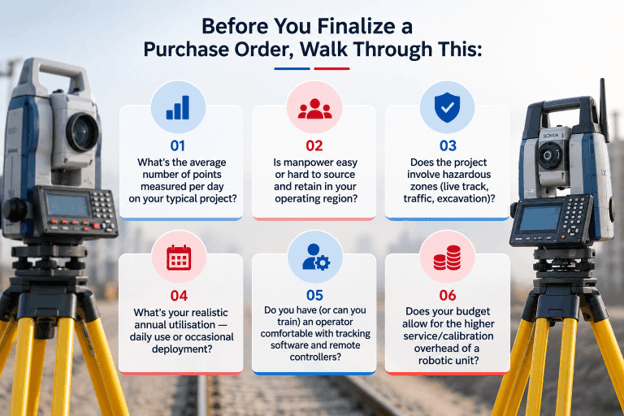
If you answered “high volume,” “hard to source labour,” or “hazardous” to most of these – lean robotic. If your answers skew toward “occasional,” “budget-tight,” or “team still learning” a mechanical unit is the smarter first step.
FAQs
Not necessarily. Accuracy is determined by the instrument’s angular and EDM specifications (e.g., 1″, 2″, 5″ accuracy classes), not by whether it’s manual or robotic. A well-specified mechanical unit can match or exceed a lower-spec robotic one in raw accuracy — automation improves speed and crew efficiency, not measurement precision itself.
This is extremely rare. Some manufacturer platforms offer modular or upgradeable series that allow a motorised or robotic head to be added later. It’s worth asking your dealer whether the specific model you’re evaluating supports this path before you buy, since not all product lines are upgrade-compatible.
They have more moving and electronic components (servo motors, tracking sensors), so service intervals and technician expertise requirements are generally higher than for mechanical units. Factor this into your total cost of ownership, not just the purchase price.
It depends on utilisation, not firm size. A small firm running one high-volume metro or highway project can recover the cost difference faster than a large firm running many small, scattered boundary surveys.
The Bottom Line
There’s no universally “right” answer between robotic and mechanical total stations only the right answer for your project mix, crew availability, and budget cycle. Many established survey and construction firms in India run both: mechanical units for routine, budget-sensitive jobs, and robotic units reserved for large-scale or manpower-constrained sites.
If you’re weighing this decision for an upcoming tender or project, it’s worth getting hands-on field guidance rather than deciding from a spec sheet alone the right fit often comes down to details a datasheet won’t tell you.
“Not sure which total station fits your next project?
Talk to our team for a field-tested recommendation — mechanical or robotic — backed by 60+ years of instrumentation experience and pan-India service support.”