From Steam Engines to Vande Bharat: How Indian Railways Quietly Transformed Itself ?
August 15, 2026

This Independence Day, it is worth looking beyond the trains we see today and reflecting on how far India’s railway infrastructure has come.
At Independence in 1947, India had roughly 54,000 km of railway routes, a fragmented network inherited after Partition, multiple track gauges and only around 388 route kilometres of electrified railway.
Today, Indian Railways is one of the world’s largest railway networks increasingly electrified, technologically advanced and moving towards higher-speed rail.
But this transformation did not happen overnight.
It is the result of nearly eight decades of steady work in railway infrastructure, engineering, electrification, track modernisation and precision measurement.
A journey through the transformation
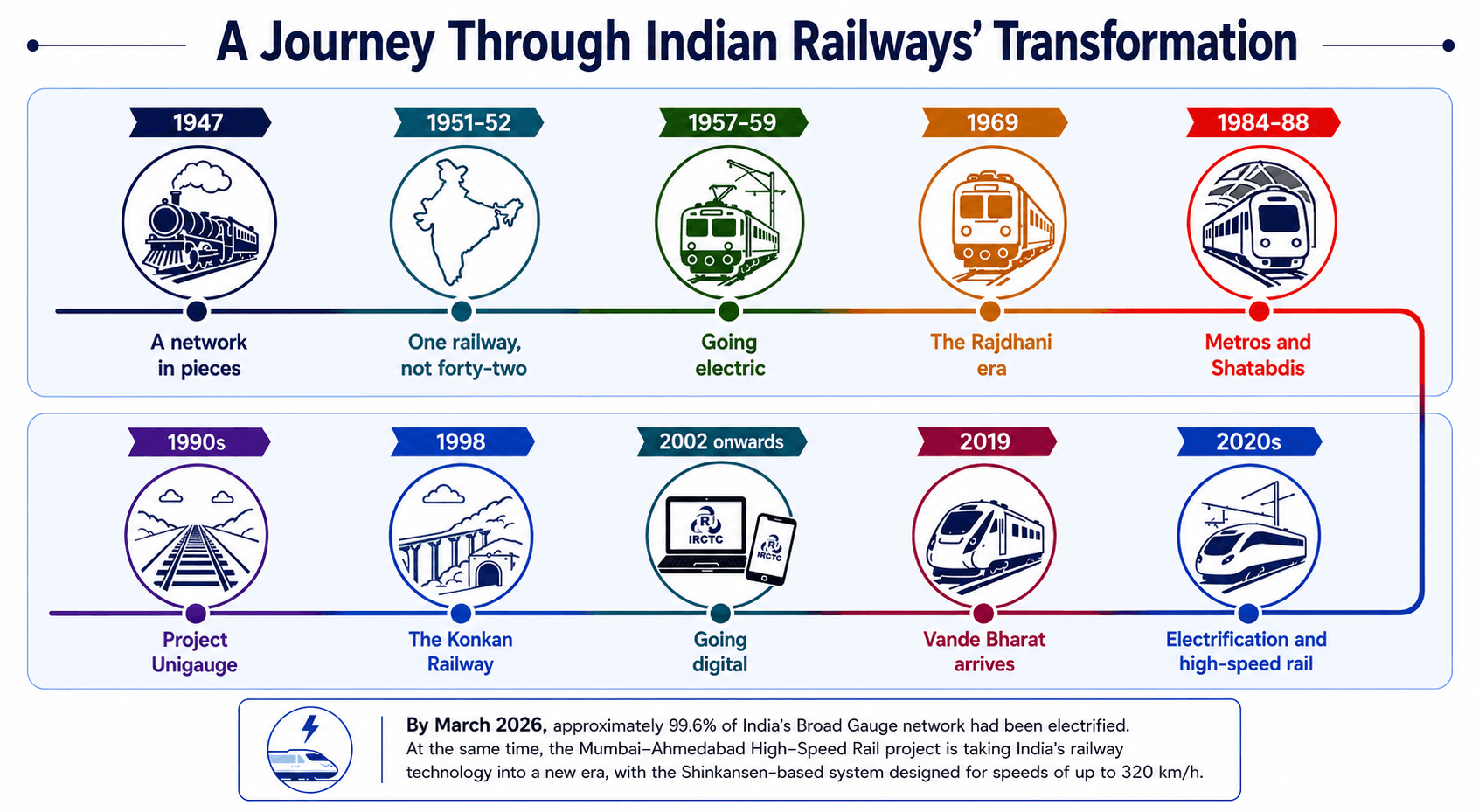
1947 — A network in pieces
India inherited a fragmented railway network after Partition, operating across multiple gauges and with very limited electrification.
1951–52 — One railway, not forty-two
Forty-two separate railway systems were progressively reorganised into six major zones, laying the foundation for a unified Indian Railways.
1957–59 — Going electric
Indian Railways adopted 25 kV AC as its standard electrification system, with the first such section commissioned in 1959.
1969 — The Rajdhani era
The Rajdhani Express between New Delhi and Howrah introduced a new benchmark for fast inter-city passenger travel.
1984–88 — Metros and Shatabdis
Kolkata Metro became India’s first metro system, followed by the Shatabdi Express, which brought a new model of fast daytime inter-city travel.
1990s — Project Unigauge
The conversion of metre- and narrow-gauge routes to 1,676 mm Broad Gauge helped create a more integrated national railway network.
1998 — The Konkan Railway
The approximately 760-km Roha–Mangaluru route became a landmark in Indian railway engineering, overcoming challenging mountainous and geological terrain through an extensive network of bridges and tunnels.
2002 onwards — Going digital
Online railway ticketing through IRCTC transformed the passenger experience and marked another major step towards a technology-driven railway system.
2019 — Vande Bharat arrives
Train 18, subsequently named Vande Bharat Express, marked a significant milestone in India’s development of indigenous self-propelled train-set technology, with a speed potential of up to 160 km/h.
2020s — Electrification and high-speed rail
By March 2026, approximately 99.6% of India’s Broad Gauge network had been electrified. At the same time, the Mumbai–Ahmedabad High-Speed Rail project is taking India’s railway technology into a new era, with the Shinkansen-based system designed for speeds of up to 320 km/h.
But there is another part of this story that rarely gets told.
Measurement.
Behind every railway milestone is the less visible work of ensuring that the infrastructure performs as it should.
As railway networks become faster and more complex, precision in measurement becomes increasingly important. Precise measurements go a long way in ensuring safety of the rail infrastructure.
At higher speeds, even a small measurement error can have consequences far beyond the measurement itself. So, the story of Indian Railways is not only about locomotives, trains and electrification. It is also a story of engineering precision measured down to the millimetre, kilometre after kilometre.
At Paragon Instrumentation Engineers Pvt. Ltd., we have been contributing to this engineering ecosystem since 1964
Developing and supplying railway measurement and inspection instruments that support accurate field measurement and infrastructure maintenance. We help railway engineers carry out the following measurements:
- Track gauge
- Cant
- Track geometry.
- Rail profiles.
- Wheel profiles.
- Alignment.
- Turnouts.
- Clearances.
- Bogie and Coupler Measurements
From steam to electric traction.
From manual inspection to advanced measurement technology.
From conventional trains to Vande Bharat and high-speed rail.
Indian Railways continues to evolve. Precision measurement continues to be part of that journey.
This Independence Day, we celebrate not just how far India has travelled but the engineering that continues to move the country forward.
Happy Independence Day !