India’s Building Code Just Got a Major Upgrade – Here’s What NBCS 2026 Means for You
July 14, 2026

After nearly a decade, India has moved from the National India’s Building Code 2016 to the National Building Construction Standards 2026. This isn’t just a policy update – it’s a fundamental shift in how buildings are designed, built, and measured.
At Paragon Instrumentation Engineers, we work with civil engineers, surveyors, and infrastructure professionals every day. Here’s our breakdown of what changes and what it means on the ground:
NBC 2016 → NBCS 2026: Key Shifts
APPROACH
2016: Prescriptive, rule-based design
2026: Performance & Engineering-Based Design – structures must now prove they perform, not just comply
HEIGHT LIMITS
2016: Fixed height restrictions by occupancy type
2026: Restrictions eliminated – replaced by engineered fire safety performance standards
SPECIAL OCCUPANCIES
2016: Basic provisions
2026: Detailed standards for Metro Stations, Data Centres, Commercial Kitchens, Car Parking, Atriums – sectors seeing massive growth in India
PERFORMANCE-BASED DESIGN
2016: No dedicated provisions
2026: Annex M introduced for complex, heritage & special buildings
What This Means for Surveyors & Civil Engineers
Performance-based design means more rigorous site data is needed upfront. Surveyors will be expected to deliver higher-precision topographic, structural, and spatial data – because engineering decisions now rest on measured reality, not standard assumptions.
- Increased demand for Total Stations, DGPS/GNSS, and Digital Levels for accurate site mapping
- Complex structures (tall buildings, metro stations, atriums) require precise as-built surveys
- Fire refuge zones, evacuation corridors, and shaft positioning must be surveyed and documented with precision
- Performance-based design audits will need ongoing measurement verification throughout construction
Impact on Railway Infrastructure
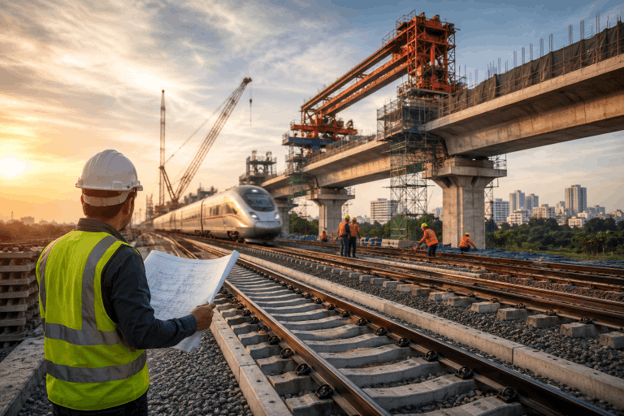
NBCS 2026 specifically calls out Metro Stations and Trainways as special occupancies with detailed fire safety, evacuation, and structural requirements. For India’s rapidly expanding metro and rail network, this means:
- Station structures must meet engineered fire compartmentation and smoke management standards
- Evacuation geometry – horizontal exits, refuge staging, fireman lifts – must be surveyed and verified
- Track alignment and OHE clearances near station structures become more critical as buildings go taller
- New metro and railway station projects will require detailed structural surveys at every stage
This aligns directly with what PIE has been supporting for decades – from track geometry measurement for Indian Railways and DMRC, to precision surveying instruments used on metro and airport projects across India.
For Business Owners & Developers
If you’re building data centers, commercial complexes, metro-adjacent properties, or industrial facilities – NBCS 2026 raises the bar. You will need certified, documented performance data at every stage. The cost of non-compliance isn’t just regulatory – it’s structural risk.
Investing in the right instrumentation at the design and construction stage is no longer optional.
At Paragon Instrumentation Engineers, we’ve been equipping India’s builders and surveyors for over 6 decades – from Total Stations and DGPS systems to track geometry trolleys and rail wear gauges used by Indian Railways, DMRC, DFCC, and leading infra contractors.
NBCS 2026 raises the standard. We help you meet it.
Connnect With Us
📞 For Survey & Construction: +91 9312403335/+91 9717109672
📞 For Railway Measurement: +91 9760091791 / 92